
7 hr 30 min
Mauna Kea Summit Sunset & Stargazing Tour
Watch the sun set from the Pacific's highest peak, then explore the night sky through a pro telescope.
Reserve
Hand-picked by our editors — only the best 5 summit experiences from 40 reviewed.
Verified partners for every tour, free cancellation where available, and instant confirmation on every booking.
7 hr 30 min
Watch the sun set from the Pacific's highest peak, then explore the night sky through a pro telescope.
Reserve
8 hr
Chase sunset from Hawaii's highest peak, then stargaze at 12,000ft with free DSLR photos included.
Reserve
6 hr
Ascend to 14,000 feet for a legendary volcanic sunset and guided stargazing experience on Hawaii’s highest mountain.
ReservePrices from verified partners. Availability updates in real time at checkout. Free cancellation policies apply where shown.
The landmarks, rooms, and views travelers on this tour remember — all visible on a single visit.
Learn about space and culture at this high-altitude hub located at 9,200 feet.
A famous volcanic hill near the station known for its pristine sunset views.
Observe the rare and endemic ʻāhinahina plant thriving in the thin, alpine air.
The support hub for the various telescopes and research facilities at the summit.
Home to world-class scientific telescopes, offering views into deep space.
Guided mauna kea observatory tickets & tours provide safer, structured access to high-altitude landmarks, whereas self-guided visitors prioritize personal pace at the Visitor Information Station. Choosing between these Mauna Kea stargazing options depends on whether you prefer managed transportation or independent exploration.
| Feature | Top pick Guided Tour | Self-Guided Visit |
|---|---|---|
Access to Summit |
Permitted with tour | Restricted to Visitor Station |
Safety and Acclimatization |
Professional monitoring included | Self-managed acclimatization |
Expert Commentary |
Astronomer-led insights | None provided |
Transportation Logistics |
4x4 vehicle provided | Requires personal 4x4 vehicle |
Cost |
Starting at 250 USD | 0 USD |
Flexibility |
Fixed schedule | Highly flexible |
| See tickets → |
Verdict: Select one of these mauna kea observatory tickets & tours for comprehensive summit access, or choose the self-guided route if you prefer a flexible, low-cost evening at the Visitor Information Station.
Choose your ticket, select your date, and reserve in under two minutes. Secure checkout handled by our verified partner.
Instant confirmation by email, with a mobile voucher you can save offline. No printing, no queuing at a collection desk.
Arrive at the entrance, show your voucher on your phone, and walk in. Most tickets include priority or skip-the-line access.
Practical details for your visit straight from our verified partners — hours, access, rules, and how to get there.
Wear warm, layered clothing and sturdy shoes as temperatures drop significantly near the Mauna Kea summit. Operators often provide parkas for Mauna Kea observatory tickets & tours.
Inspect your vehicle and gear for invasive species before departure. Security checkpoints are in place for Mauna Kea observatory tickets & tours at the 9,200 ft level.
Astrophotography is popular, but respect observatory grounds and cultural sites. Avoid using flash near stargazing areas during your Mauna Kea observatory tickets & tours experience.
The Visitor Information Station is wheelchair accessible, but the high-altitude, gravel environment at the Mauna Kea summit presents significant mobility challenges.
Children under 13, pregnant women, and those with health conditions are strongly advised to remain at or below the Visitor Information Station for their safety.
No food is sold at the summit; bring water and snacks for your Mauna Kea observatory tickets & tours. Stay hydrated to mitigate high-altitude effects.
Best time to go, insider tips, nearby landmarks, and the cancellation fine print — flip through to skim what matters to you.
Flexible, no hidden fees.
Mauna Kea observatory tickets & tours bookings vary by operator, but most offer full refunds if cancelled 48 hours in advance. Entrance to the Visitor Information Station is 0 USD.
Mauna Kea rises 4,207 metres above sea level, yet measured from its base on the ocean floor it stands taller than Everest. That submerged bulk explains the mountain's shape: a shield volcano broad enough to carry its own weather, its summit sitting above roughly forty percent of the Earth's atmosphere. Nineteen percent of nights here are cloud-free. Humidity is negligible. Air turbulence is among the lowest measured anywhere on the planet. Astronomers noticed. The first telescope reached the summit in 1968, a 0.6-metre instrument placed after Gerard Kuiper surveyed the cinder cones for seeing conditions. The University of Hawai'i's 2.2-metre telescope followed in 1970. Today the Maunakea Observatories comprise thirteen facilities operated by institutions from eleven countries: the twin 10-metre Keck telescopes, the 8.2-metre Subaru, the Canada-France-Hawaii Telescope, the James Clerk Maxwell submillimetre dish, the Submillimeter Array. Between them they hold discoveries that reshaped the field — the confirmation of the Milky Way's central black hole, the first detection of an interstellar object passing through the solar system, atmospheric measurements of planets orbiting other stars. Anyone comparing mauna kea observatory tickets & tours is looking at the most productive ground-based observing site in the Northern Hemisphere. The mountain was sacred long before it was scientific. In Hawaiian cosmology the summit region is the meeting place of Wākea, the sky father, and Papahānaumoku, the earth mother. Adze quarries near the summit supplied basalt for tools across the archipelago; burial sites and shrines remain. Lake Waiau, at 3,970 metres, is one of the highest lakes in the United States and holds cultural significance as a place of offering. This dual identity — observatory and wahi pana, a storied place — sits at the centre of ongoing questions about who decides the mountain's future. The architecture reflects the constraints. Domes are white to reflect daytime heat; interiors are chilled to match night air so rising warmth does not blur the image. Roads are unpaved in sections deliberately, to limit dust plumes. The Maunakea Visitor Information Station at 2,804 metres exists as a physiological threshold: bodies need time at that elevation before continuing higher. Free entry to the Visitor Information Station makes it the practical gateway for most visitors, and nearly all Hawaiʻi Island landmarks itineraries route through it. The summit itself has no public facilities, no water, no shelter — which is why guided mauna kea observatory tickets & tours tours handle transport, oxygen, and the descent in darkness.
"Measured from its base on the ocean floor, Mauna Kea stands taller than Everest."
A step-by-step walkthrough of the visit — what you'll see, how long each stage takes, and the details that matter.
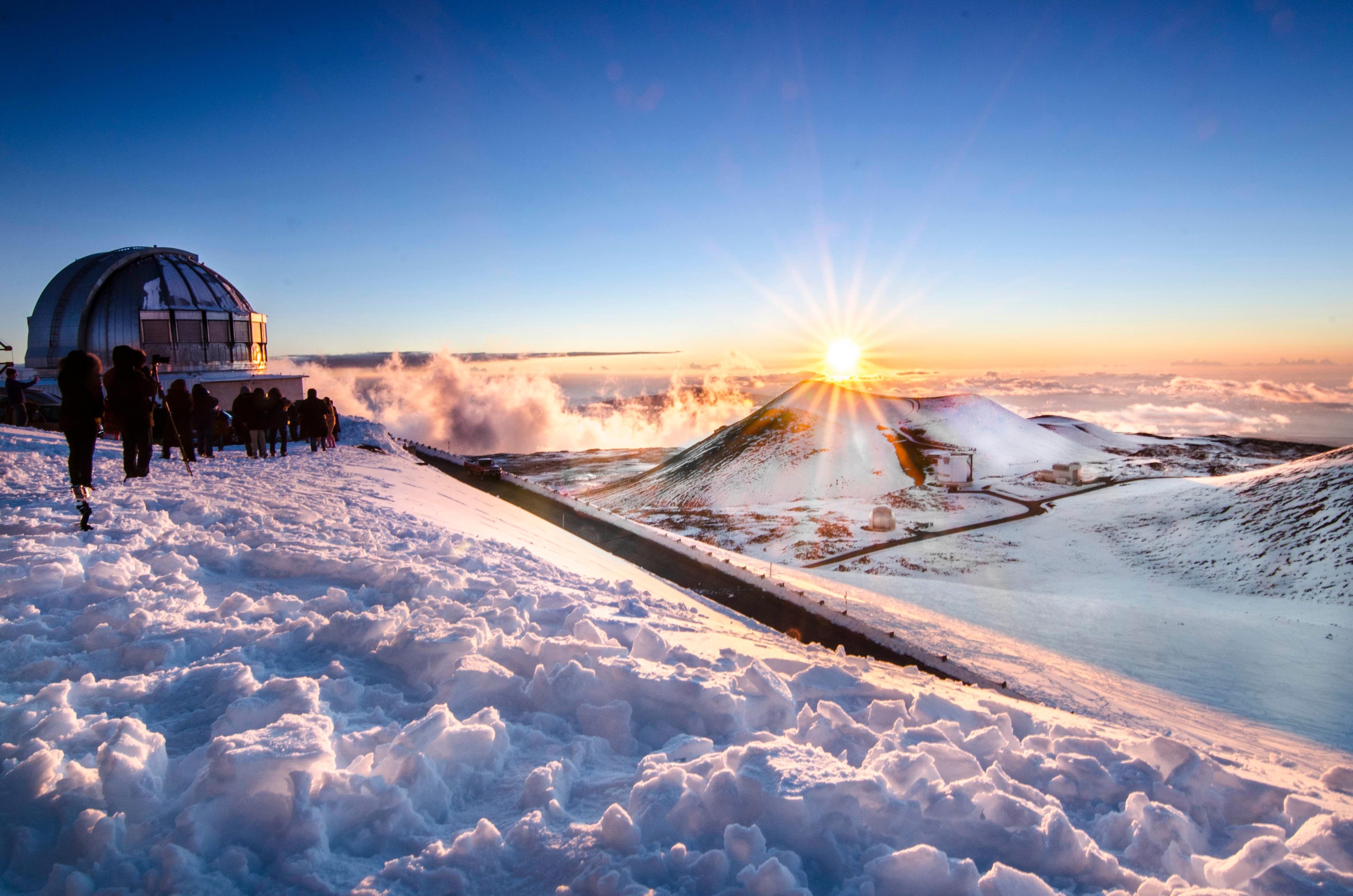
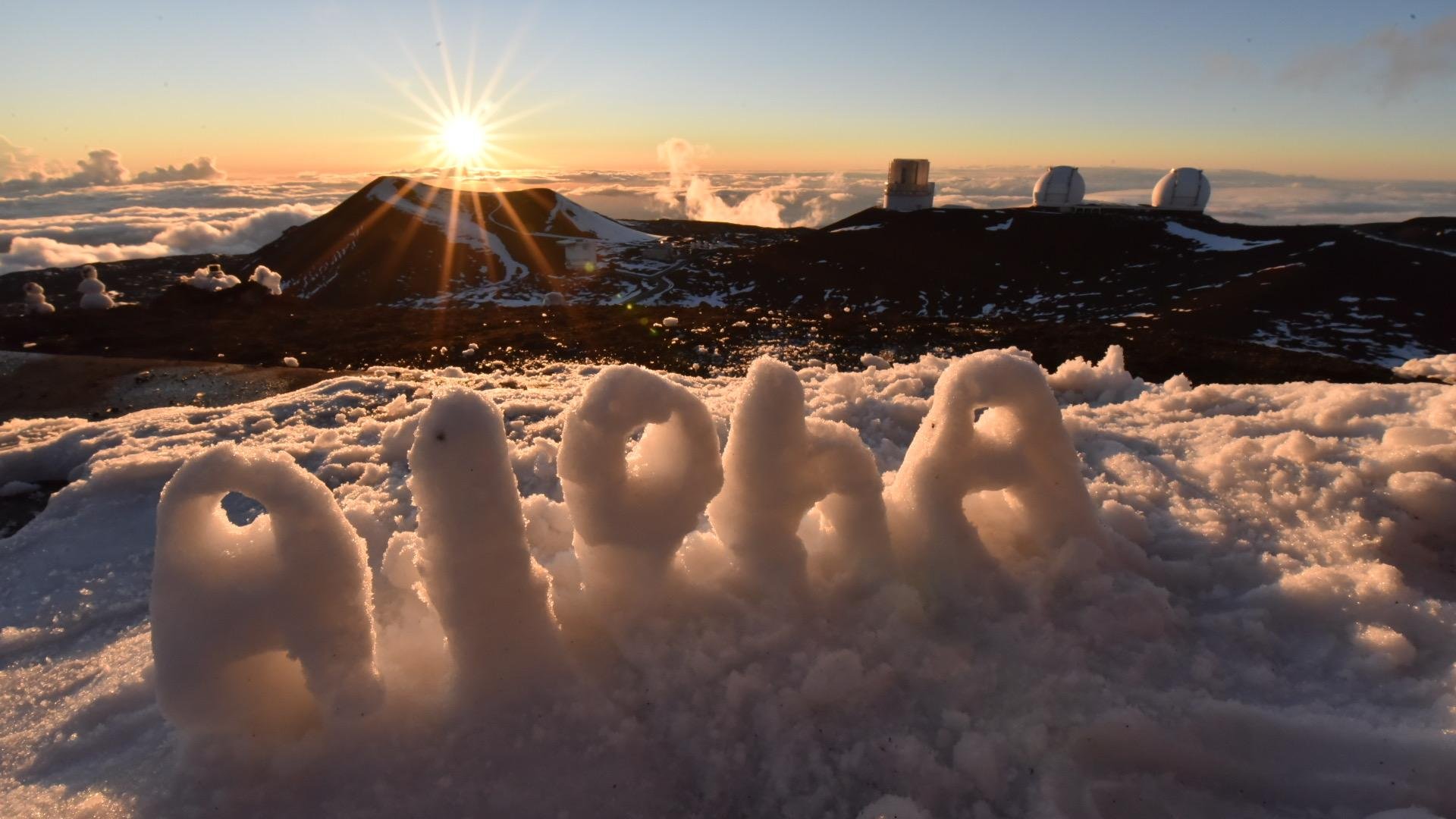
You leave Hilo or Kona in the afternoon, and the road climbs through cane land, then ranch grass, then nothing much at all. Your guide stops at the Maunakea Visitor Information Station, 2,804 metres up, and hands you a jacket. You walk slowly here on purpose. Thirty to forty-five minutes of standing around drinking water is not filler — it is how your blood adjusts before the last 1,400 metres. Then the switchbacks. The four-wheel-drive vehicle grinds up unpaved sections, and the horizon drops away until you are looking down at cloud. At the summit you step out into wind that reads ten degrees colder than the number on the thermometer. The domes stand around you: Keck's twin shells, Subaru's cylinder, the submillimetre dishes angled at nothing you can see. The sun sets into the Pacific below your feet — the shadow of the mountain stretches east across the ocean, a triangle forty kilometres long. You descend before full dark, because nobody stargazes at 4,207 metres. Lower down, your guide sets up a telescope on a pull-out and the sky arrives all at once. Saturn's rings. The Andromeda Galaxy as a smudge you can actually resolve. Your mauna kea observatory tickets & tours tour includes hot cocoa by then, and on photo departures a portrait of you under the Milky Way. You reach the coast around midnight, cold-cheeked and quiet.
The Visitor Information Station is open daily from 09:00–21:00.
No, the entry to the Visitor Information Station is 0 USD.
Bring warm layers, water, snacks, and a camera for your mauna kea observatory tickets & tours experience.
Children under 13 should not ascend beyond the Visitor Information Station due to altitude risks.
Spend at least 30 minutes acclimatizing at the Visitor Information Station before proceeding higher.
Yes, free parking is available at the Visitor Information Station for those visiting on mauna kea observatory tickets & tours.
Restrooms are located at the back of the Visitor Information Station.
Arrive between 09:00–20:00 for optimal acclimatization and stargazing conditions.
Yes, 4WD is required for any travel above the Visitor Information Station.