
English| EUR
Suggested for you
More currencies
Choose a language
Few visitors expect to shiver in Hawai‘i, yet the mountain above Hilo routinely drops near freezing while the coast stays warm. This mauna kea stargazing temperature guide sets out what the thermometer actually reads after sunset, at both the Visitor Information Station and the 13,796-foot summit. It also explains why the wind, not the air, is what most people remember.
Quick answer
Night-time air on Maunakea typically sits between roughly 30°F and 45°F (-1°C to 7°C) at the 9,200-foot Visitor Information Station, and near or below freezing at the summit year-round. Wind of 20–30 mph can make it feel far colder. Winter nights bring snow and ice; summer offers little relief, since altitude, not season, drives the chill.
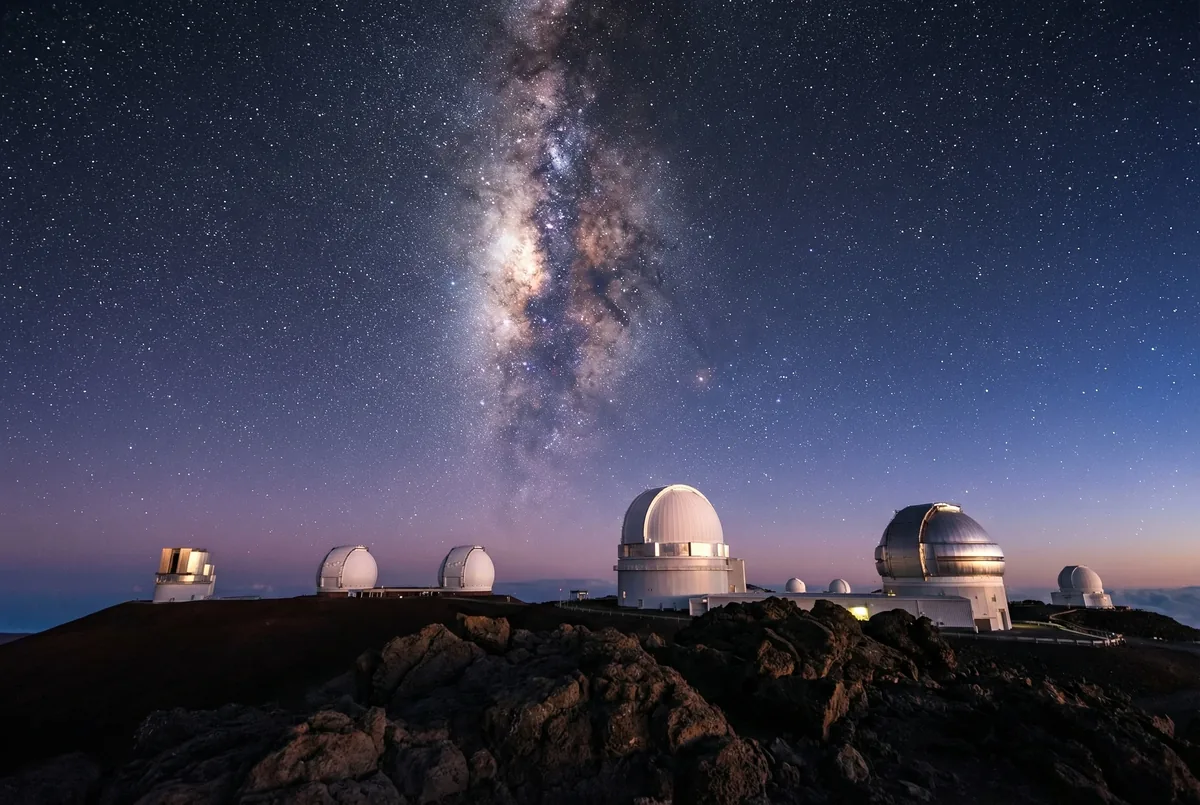
The summit of Maunakea holds permanent ice in a tropical archipelago. Lake Waiau, sitting above 13,000 feet, freezes over in winter, and the cinder slopes around the Keck, Subaru and Gemini domes can carry snow into spring. That contradiction is the whole story behind mauna kea stargazing temperature: the mountain rises through roughly 40 percent of Earth's atmosphere, and air cools about 3.5°F for every thousand feet of that climb. A beach morning in Hilo at 82°F becomes something closer to a mountain night in the Rockies by the time the road reaches the Onizuka Center for International Astronomy. What visitors are dealing with, then, is not weather in the ordinary Hawaiian sense but altitude physics. The Visitor Information Station at 9,200 feet is where most public stargazing happens, and it is measurably milder than the summit ridge above it — though still cold enough that hands stop working on camera dials. Above the inversion layer near 7,000 feet, humidity collapses, skies clear, and heat radiates away from the ground with nothing to trap it. The same dryness that gives the mountain its legendary seeing conditions is what strips warmth out of the air the moment the sun leaves. Trade winds accelerate over the shield volcano's flanks, so a still reading on a thermometer rarely matches what a body feels standing on open lava cinder. Anyone comparing a maunakea night sky tour against a coastal option should read the forecast as a wind report first and a temperature report second. The practical use of this information is expectation-setting. Nights vary, and the mountain does not negotiate: rangers close the summit road for ice, vog and snow with little notice, and clouds can settle across the saddle even when Hilo is clear. Checking the mountain-specific forecast published by the University of Hawai‘i on the day of travel matters more than any seasonal average. Understanding mauna kea stargazing temperature also reframes the schedule — the Visitor Information Station keeps 09:00–21:00 hours daily with free entry, so the cold window overlaps only the last part of the day. Arriving in daylight, while the air is still tolerable, gives the body time to adjust to thin air before darkness drops the numbers again. Guided Mauna Kea stargazing tours exist partly for this reason: they carry the layers, the hot drinks and the judgement about when the mountain is worth the drive.
“The same dryness that gives the mountain its legendary seeing conditions is what strips warmth out of the air the moment the sun leaves.”
The best time for stargazing on Mauna Kea is during the drier months of April through October, when clearer skies provide better visibility. Because the Visitor Information Station sits at an elevation of 9,200 feet, visitors should expect cold temperatures year-round, typically ranging between 30°F and 50°F at night.
Mild days, cold nights (35°F–55°F)
Clear skies are common, though evening winds can increase the chill factor.
Stable conditions (30°F–50°F)
These months often provide the most consistent weather patterns for astronomical observation.
Colder with precipitation (25°F–45°F)
Snow and ice can occur at higher elevations, occasionally limiting access to the summit area.
Rapid temperature drop as sun sets
Temperatures fall quickly once the sun dips below the horizon, requiring thermal layers.
Verdict: The most favorable window is Tuesday to Thursday during the shoulder months of April or October, providing a balance of manageable crowds and stable high-altitude conditions.
Summit temperatures at Mauna Kea routinely drop below freezing after dark, so the gear you pack weeks ahead determines how long you can actually stay out under the stars.
The Maunakea Visitor Information Station operates on a daily schedule throughout the week. Arriving within the optimal window allows visitors sufficient time to acclimate to the high-altitude environment before temperatures drop after sunset.
The Mauna Kea Visitor Information Station is located along Maunakea Access Road in Hilo, HI 96720. Reaching this elevation involves a significant ascent that results in a rapid decrease in ambient temperature.
Saddle Road (State Route 200) to Maunakea Access Road
Saddle Road (State Route 200) to Maunakea Access Road
Follow the best arrival window of 09:00–20:00. Arrive early to acclimate and secure parking before sunset for optimal stargazing conditions.
Access to the Mauna Kea Visitor Information Station is open to the public without admission charges. Visitors should plan for the logistical requirements of high-altitude travel rather than ticket costs.
Verdict: A typical adult pays 0 USD for entry, though travel expenses depend on your chosen mode of transportation and gear rental requirements.
Everything you need to know about mauna kea stargazing temperature
The mauna kea stargazing temperature often drops to freezing or below, even in summer, because of the high altitude of 9,200 feet at the visitor station. Visitors frequently encounter conditions significantly colder than at sea level. Temperatures remain low throughout the night, so proper preparation is essential. It is common for the mauna kea stargazing temperature to fall rapidly once the sun sets over the horizon. This cooling occurs due to the dry, thin atmosphere at high elevation which cannot retain surface heat effectively. Planning for these fluctuations is a critical part of your visit. Entry to the visitor station area is 0 USD, as there is no entrance fee. You can explore the facility and enjoy the night sky at no cost. The best arrival window is 09:00–20:00 to help with altitude acclimation and parking. While children are allowed, parents should be aware that the high altitude and cold mountain temperatures can be challenging for younger visitors. Ensure that children are dressed in multiple layers to stay warm. Proper gear including heavy jackets, gloves, and warm pants is necessary to stay safe in the high-elevation climate. Avoid thin clothing, as the temperature difference from the coast is dramatic. The visitor station is open daily from 09:00–21:00 for public access. Always check weather updates before heading up the mountain.
Private Stargazing Experiences
Read more GuideStargazing Tips and Requirements
Read more GuideVisitor Center and Program Info
Read more GuideIs Stargazing Worth It?
Read more Tickets & toursTours from Kona
Read more Tickets & toursTours from Hilo
Read more Tickets & toursObservatory Tours & Tickets
Read more